go to the AUS-e-TUTE homepage  
home student log-in Join AUS-e-TUTE teacher log-in contact


Corrosion

Key Concepts

  • Corrosion: the oxidation of metals by certain substances such as water and oxygen in the environment.

  • Rusting of iron is a common form of corrosion.

  • Noble Metal: a metal resistant to corrosion and found uncombined in nature, eg, gold and silver. These are also known as Cathodic, or Protected, Metals.

  • Ignoble Metal: a metal that corrodes. These are also known as Anodic, or Corroding, Metals.

  • Passivating metal: a reactive metal that forms an inactive coating as a result of reacting with substances such as oxygen and water, eg, aluminium and chromium.

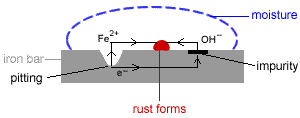
  • In general, corrosion is a spontaneous electrochemical process* which requires:
  1. an anode where oxidation occurs

  2. a cathode where reduction occurs

  3. a metal path to allow for the flow of electrons

  4. an electrolyte

  • Common methods of corrosion prevention are:

  1. Painting

  2. Plating with another metal

  3. Cathodic protection

  4. Alloying with another metal

*Biological activity can also corrode metals.

Examples: Corrosion (Rusting) of Iron and Preventing Corrosion (Rusting)

Become an AUS-e-TUTE Member and get the full tutorial including worked examples.

AUS-e-TUTE Membership Advantages

advertise on the AUS-e-TUTE website and newsletters
 

Search this Site

You can search this site using a key term or a concept to find tutorials, tests, exams and learning activities (games).
 

Become an AUS-e-TUTE Member


Subscribe to our Free Newsletter

Email email us to
subscribe to AUS-e-TUTE's free quarterly newsletter, AUS-e-NEWS.

AUS-e-NEWS quarterly newsletter

AUS-e-NEWS is emailed out in
December, March, June, and September.


Ask Chris, the Chemist, a Question

The quickest way to find the definition of a term is to ask Chris, the AUS-e-TUTE Chemist.

Chris can also send you to the relevant
AUS-e-TUTE tutorial topic page.


Related AUS-e-TUTE Topics

Oxidation and Reduction

Galvanic (or Voltaic) Electrochemical Cells

Displacement Reactions (Activity Series)

Electrolysis and Electrolytic Cells

Oxidation Numbers (States)

Calculating Electrochemical Cell EMF (voltage)

Writing cell half-equations

Faraday Laws of Electrolysis

Batteries and Fuel Cells

Reaction Rates


Bookmark AUS-e-TUTE

  Bookmark this site!

Bookmark and Share


© AUS-e-TUTE