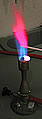
| Flame tests are usually used to detect the presence of metals, but some semi-metals (metalloids) and non-metals (such as phosphorus) can also be detected.
There are a number of limitations of flame tests:
- Flame tests cannot detect all elements.
Some elements produce similar flame colours.
Many elements produce no change in flame colour.
- Flame tests cannot usually detect low concentrations.
- Impurities can mask the flame colour.
Sodium, with its intense yellow flame, is capable of masking the colour produced by other elements if it is present as an impurity.
Sometimes, viewing the flame through blue glass can filter out the yellow of sodium's flame.
|
| element |
flame colour |
|---|
| antimony |
pale green |
| arsenic |
blue |
| barium |
yellowish green |
| boron |
bright green |
| calcium |
orange to red |
| cesium |
blue |
| copper |
green or blue |
| indium |
blue |
| iron |
gold |
| lead |
blue |
| lithium |
pink to red |
| magnesium |
bright white |
| manganese(II) |
yellowish-green |
| molybdenum |
yellowish-green |
| phosphorus |
pale bluish-green |
| potassium |
lilac to violet |
| rubidium |
red to violet |
| selenium |
azure blue |
| sodium |
intense yellow |
| strontium |
crimson to red |
| tellurium |
pale green |
| thallium |
green |
| zinc |
bluish-green |
|