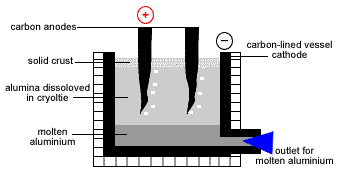
Hall-Heroult Cell for the Production of Aluminium
Key Concepts
Alumina, Al2 O3 , is extracted from the mineral bauxite using hot concentrated sodium hydroxide solution in the Bayer Process.
Alumina is dissolved in cryolite, Na3 AlF6 , to lower the melting point.
Aluminium is produced by the electrolysis of molten alumina in a Hall-Heroult cell.
A Hall-Heroult Cell is a carbon lined reaction vessel which acts as the cathode with carbon anodes dipped into the alumina-cryolite electrolyte.
The amount of aluminium produced can be calculated using Faraday's Laws of Electrolysis .
Hall-Heroult Cell Example
Become an AUS-e-TUTE Member and get the full tutorial .
AUS-e-TUTE Membership Advantages
 
Search this Site
You can search this site using a key term or a concept to find
tutorials, tests, exams, learning activities (games), drills, worksheet and quiz wizards.
 
Become an AUS-e-TUTE Member
 
Subscribe to our Free Newsletter
Email to
subscribe to AUS-e-TUTE's free quarterly newsletter, AUS-e-NEWS .
AUS-e-NEWS is emailed out in December, March, June, and September.
 
Ask Chris, the Chemist, a Question
The quickest way to find the definition of a term is to ask Chris, the AUS-e-TUTE Chemist .
Chris can also send you to the relevant AUS-e-TUTE tutorial topic page.
 
AUS-e-TUTE's Blog
Read AUS-e-TUTE's blog AUS-e-BLOG .
Keep up-to-date with
chemistry news from around the world
updates to the AUS-e-TUTE website.
 
Related AUS-e-TUTE Topics
Electrolysis of Molten Salts
Electrolysis of Aqueous Salt Solutuions
Electrolysis - Electrolytic Cells
Oxidation and Reduction
Displacement Reactions
Faraday's Laws of Electrolysis
Production of Sodium : Down's Cells
 
 
Bookmark AUS-e-TUTE
  Bookmark this site!
 
Warning Some content on this page could not be displayed.Please enable javascript to view all page content.