Infrared Spectroscopy |
Key Concepts
- Infrared (ir) spectroscopy is used to identify particular bond types and functional groups in organic molecules by measuring a substance's absorption of infrared radiation at different frequencies.
- Wavenumber is the number of wavelengths per centimetre (cm-1). Organic groups show absorbance in the range ~1000 to 3000 cm-1.
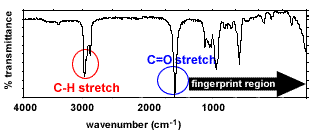
- Infrared (ir) spectra show a 'fingerprint' region between ~1000 and 400 cm-1 which is specific to a particular compound. The ir spectrum of an unknown compound can be compared to known spectra in order to identify the unknown compound.
Infrared Spectrometer
- Atoms in molecules are continually vibrating.
- This vibrational energy is quantised.
- When molecules absorb infrared radiation they become hot and the atoms and molecules vibrate more vigorously.
- Molecules absorb infrared radiation at particular wavelengths depending upon which chemical bonds are present in the molecule.
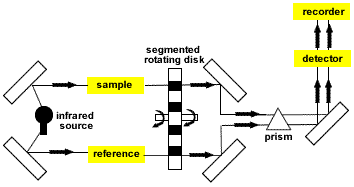
| The Infrared (ir) Spectrometer

|
- infrared radiation is produced by electrically heating a filament which is divided by mirrors into 2 beams, a reference beam and a sample beam.
- In the sampling area, a segmented rotating disk allows each beam to pass through alternately.
- The reference beam and the sample beam are combined into a beam of alternating segments.
- The detector measures the heat energy and the recorder records the results as a plot of percent absorption (or transmittance) as a function of wavenumber (cm-1) or wavelength (μm).
|
Infrared (ir) Spectra
Particular chemical bonds absorb energy at a particular wavelength (wavenumber) regardless of the compound the bond is in.
Some examples are given below:
| molecular vibration |
wavenumber (cm-1) |
wavelength (μm) |
| C-Cl |
700-800 |
14.3-12.5 |
| C-C |
750-1100 |
13.3-9.1 |
| C-O |
1000-1300 |
10-7.7 |
| C=C |
1610-1680 |
6.2-6.0 |
| C=O |
1670-1750 |
6.0-5.7 |
| O-H (acids) |
2500-3300 |
4.0-3.0 |
| C-H |
2850-3300 |
3.5-3.0 |
| O-H (alcohols) |
3200-3550 |
3.1-2.8 |
| N-H (primary amines) |
3350-3500 |
3.0-2.9 |
Examples of Infrared (ir) Spectra
| The infrared (ir) spectrum of hexane, CH3CH2CH2CH2CH2CH3. |
Bond types present - C-H stretches
(2850-3300 cm-1)
|
 |
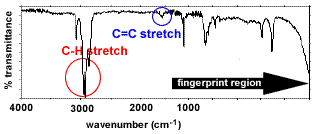
| The infrared (ir) spectrum of 1-hexene, H2C=CHCH2CH2CH2CH3. |
Bond types present - C-H stretches
(2850-3300 cm-1) - C=C stretches
(1610-1680 cm-1)
|
 |
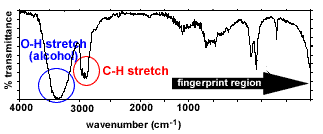
| The infrared (ir) spectrum of ethanol, CH3CH2OH. |
Bond types present - O-H (alcohol) stretches
(3200-3550 cm-1) - C-H stretches
(2850-3300 cm-1)
|
 |
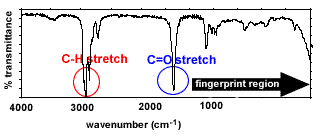
| The infrared (ir) spectrum of octanal,   | CH3CH2CH2CH2CH2CH2CH2 | O || C  | H  |
|
Bond types present - C-H stretches
(2850-3300 cm-1) - C=O stretches
(1670-1750 cm-1)
|
 |
| The infrared (ir) spectrum of 2-pentanone,   | CH3CH2 | O || C  | CH2CH3 |
|
Bond types present - C-H stretches
(2850-3300 cm-1) - C=O stretches
(1670-1750 cm-1)
|
 |

|
|
|